
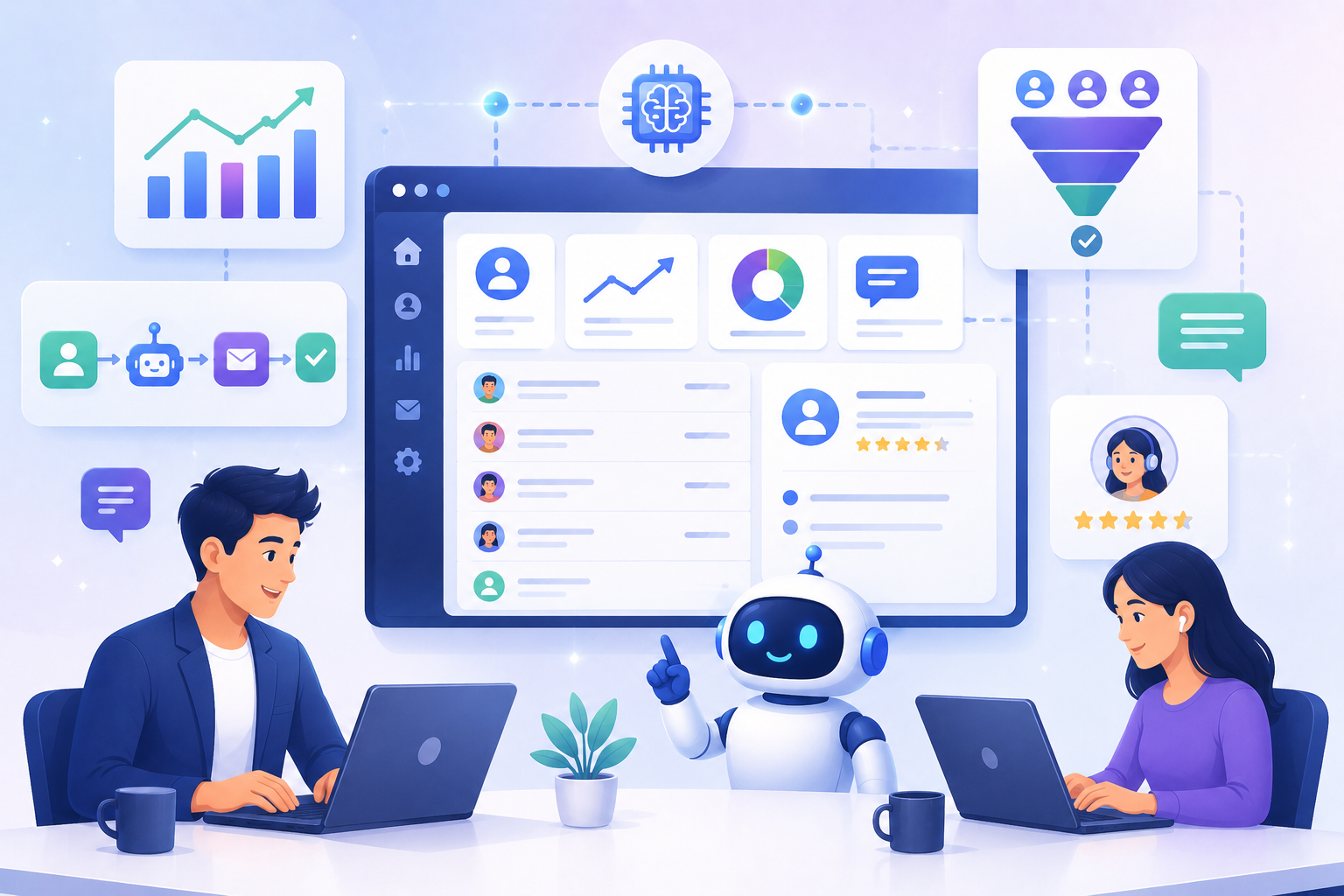
Discover how AI CRM software transforms sales and customer service with automation. Learn the key features, market trends, and top platforms driving growth.
You may think AI CRM software is just another upgrade in the long line of business tools, but it’s more like a generational leap.
Imagine the old CRM as the trusted elder in your company. They are steady and dependable, but slow to adapt when the pace of digital markets accelerates.
Now picture AI CRM as the sharp young professional who actively predicts customer needs, nudges your team toward the right actions, and clears away the repetitive clutter before anyone notices.
Other big companies aren’t adopting it for fun; they’re doing it because customers demand instant, context-aware responses and competitors are racing ahead.
Manual operations feel like dragging your feet in a sprint, while AI agents for sales automate pipelines, personalize outreach, and keep momentum alive.
In this article, I’ll walk you through how this new generation of CRM reshapes sales and service, which features matter most, and which platforms deserve your attention.
Understanding the Core: What Defines Modern AI CRM Software?
To evaluate AI CRM effectively, you first need to understand what separates it from the traditional version and why the gap matters.
Definition and the shift from passive to proactive systems
Traditional CRM is like a digital filing cabinet that works passively. It waits for you to feed it data, then spills out reports when asked.
AI CRM flips that script. Instead of sitting quietly, it’s more like a sharp assistant who constantly scans the room, notices patterns, and suggests the next best move before you even think to ask.
The triple threat: ML, NLP, and generative AI
Three core technologies power modern AI CRM, driving the shift from passive data logging to intelligent, predictive execution.
- Machine Learning and predictive analytics: identify behavioral patterns across customer interactions and continuously refine their predictions without manual reconfiguration.
- Natural Language Processing (NLP): allows the platform to interpret human language across customer interactions and respond in ways that feel natural, making AI-assisted conversations feel genuinely helpful.
- Generative AI: handles content creation at scale, like drafting follow-up emails, summarizing call notes, and building workflow templates to reclaim hours of productive time.
The architectural layers: data, intelligence, and application
Every capable AI CRM rests on a foundation of data that gathers customer touchpoints and intelligence that processes it into predictions.
From there, dedicated applications deliver the necessary dashboards, alerts, and automated sequences. When these layers sync, the system compounds value with every interaction, growing sharper and more useful over time.
The Economic Impact: Market Trends and Statistics
AI CRM software isn’t just a shiny new tool; it’s reshaping the economics of customer management.
The numbers tell the story: the market is expanding at a pace that feels less like steady growth and more like a rocket launch.
Global market expansion
In 2025, the global AI CRM Software market was already valued at around $112.91 billion. By 2026, it’s projected to hit $126.17 billion, and by 2034, it’s expected to soar past $320.99 billion.
This sustained growth shows that not just enterprise giants are fueling the climb; mid-sized and even small businesses are jumping in, proving that AI-powered tools are no longer out of reach.
Adoption rates among professionals
It’s not just about dollars; it’s about people. Salesforce reports that 83% of sales professionals now rely on AI CRM to cut through daily clutter.
IDC adds that 72% of business leaders rank AI-driven systems as a top priority for customer loyalty and engagement.
These figures confirm that AI CRM has moved past the early-adopter phase; it is now the expected standard.
Transforming the Sales Pipeline with Intelligent Automation
If the sales funnel used to feel like a maze, AI CRM is the guide that clears the path and points you straight to the finish line. Instead of friction at every stage, intelligent automation smooths the journey from prospecting to close.
Precision lead scoring and qualification
Not all leads deserve equal attention, and AI CRM platforms know how to tell the difference by analyzing behavioral signals like page visits, demo requests, and response timing.
Tools like Creatio even let teams build qualification workflows with no-code AI, so the process feels less like manual sorting and more like smart prioritization.
Automated outreach and smart follow-up systems
Timing is one of the most underrated variables in sales, and AI CRM removes the guesswork.
Rather than relying on a rep’s intuition or a calendar reminder, the system tracks engagement signals and triggers outreach at the optimal moment.
Predictive sales forecasting and pipeline optimization
AI CRM doesn’t just track where your deals are — it predicts where they’re headed by analyzing historical win rates, deal velocity, and engagement depth.
The system generates forecasts that are consistently more reliable than manual estimates.
Pipedrive has built its reputation on this premise: a visual pipeline interface backed by AI insights that helps sales teams identify bottlenecks and reallocate resources before opportunities slip away.
Elevating Customer Service: Speed, Personalization, and Presence
Sales pipeline improvement is only half the equation. What happens after the deal closes matters just as much, and AI CRM is equally transformative on the service side.
Reducing friction with faster response times
Modern customers expect fast resolutions. AI CRM enables this by automating ticket support queues, routing inquiries to the right agents, and handling routine questions instantly; it cuts down resolution times dramatically.
Zendesk leans into this strength, deploying AI-driven workflows that reduce average resolution times across high-volume support environments.
Hyper-personalization: creating emotional connections
Personalization isn’t just about dropping a first name into an email. It means recognizing purchase history, communication style, and even emotional tone.
An intelligent AI agent for customer support enables businesses to resolve common service situations in seconds while maintaining a tone that fits the individual.
Vtiger stands out here, using AI to tag and track customer sentiment across interactions, allowing service teams to identify and address dissatisfaction before it escalates into churn.
Mastering the omnichannel experience
Customers jump between email, chat, social, and phone without thinking twice. AI CRM creates a unified view of those touchpoints, so every agent sees the full story no matter where the conversation started.
HubSpot leads in this regard, with a deeply integrated marketing, sales, and support ecosystem that ensures continuity across every channel.
This isn’t just customer service —it’s presence, speed, and personalization woven into every interaction.
Critical Features Every Business Should Seek
Not all AI CRM platforms are built the same. The difference lies in the features, and choosing the right ones determines whether your CRM is simply functional or genuinely transformative.
Workflow management and scalability
An AI CRM should reduce the administrative load on your team, not add configuration complexity.
Look for platforms that offer pre-built automation templates, intuitive workflow builders, and the ability to scale rules and sequences as your team grows without requiring a dedicated operations resource.
Predictive analytics and error correction
The best systems don’t just highlight opportunities; they warn you when trouble is brewing. A deal that’s been dormant too long, a disengagement signal, a pipeline metric trending in the wrong direction: predictive analytics give you the chance to act before losses pile up.
Custom reporting and deep analytics
Dashboards are nice, but real insight comes from tailoring reports to the metrics that matter most to your strategy.
Prioritize platforms that let you build custom analytics, so decisions are guided by substance, not just flashy demo charts. This is where AI CRM stops being software and starts becoming strategy.
The “Early Success” Advantage: Real-World Results
Jumping in early with AI CRM is stacking the odds in your favor. The data shows that companies that embrace these tools sooner consistently outperform those that wait on the sidelines.
Achieving sales goals with AI CRM software
A Freshworks study found that businesses incorporating Generative AI into their CRM workflows are 83% more likely to exceed their sales targets compared to those using traditional methods.
The reason is simple: when AI takes care of content generation, routing, and scheduling, reps spend less time buried in admin and more time in conversations that actually drive revenue.
Lead generation and growth potential
Industry data suggests that companies adopting AI CRM tools see up to a 129% increase in lead generation within the first year of deployment.
Sure, results vary by sector and execution, but the trend is clear: those who move first climb faster. Early adoption will improve pipeline health; it sets the stage for steeper growth curves and stronger long-term momentum.
Conclusion: Embracing the Future of Customer Relationships
AI CRM software has cleared the hype phase. It now delivers practical, measurable advantages to businesses that implement it thoughtfully.
The right platform predicts behavior before it becomes a problem, optimizes your pipeline in real time, and keeps your team focused on the work that actually drives revenue.
This isn’t just about choosing another tool for your stack. Selecting the right AI CRM software is a strategic decision that shapes how your business grows, competes, and sustains success.