
Introduction
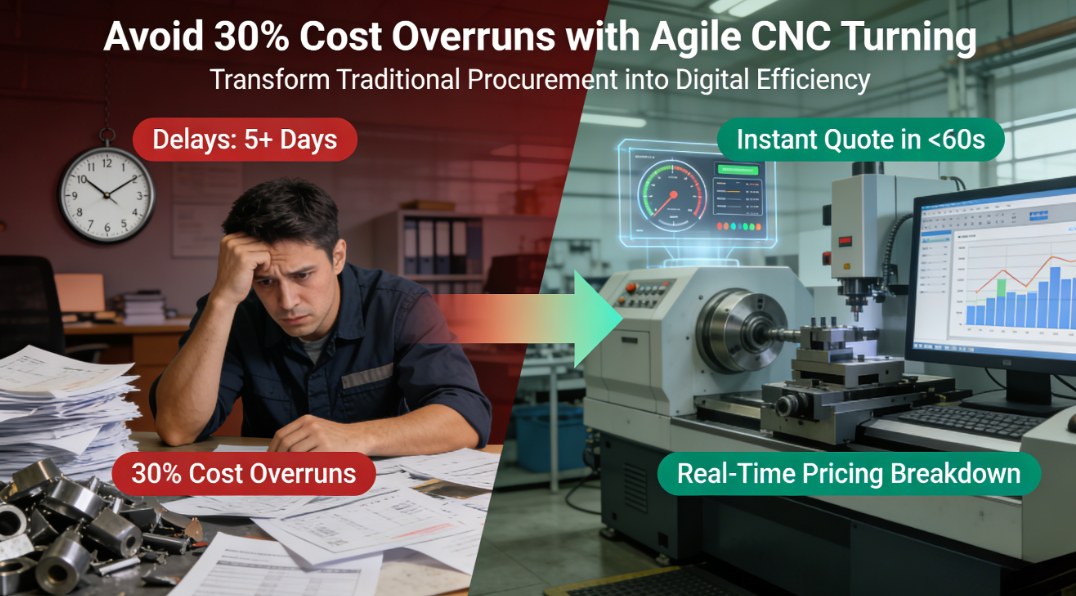
In today’s competitive manufacturing landscape, engineers frequently grapple with cost overruns averaging 30%, delayed deliveries, and a lack of transparency when procuring CNC turning services. These issues often stem from traditional procurement processes that rely on manual quoting, leading to inefficiencies and project bottlenecks. While competitors like Protolabs offer online solutions, they often fall short in providing deep customization and clear pricing structures.
This article explores how a digital supply chain transformation, integrating agile CNC turning services with instant quoting and transparent pricing, can address these challenges. Through real-world cases and best practices, we’ll demonstrate how engineers can achieve significant cost savings, improved quality, and faster time-to-market.
What Are the Key Challenges in Traditional CNC Turning Procurement?
Traditional CNC turning procurement is fraught with inefficiencies that escalate costs and delay production. Manual processes dominate, requiring engineers to submit designs and wait days for quotes — creating a significant bottleneck in fast-paced projects.
1. Manual Quoting Delays and Inaccurate Estimates
The reliance on human-dependent quoting often introduces errors and inconsistencies. Without automated systems, suppliers struggle to account for variables like material waste, tool wear, and machine utilization in real time. Industry data, including reports from McKinsey, highlights that manual workflows contribute directly to 30% cost overruns and timeline slippages. These delays force engineers to make decisions based on outdated or incomplete information.
2. Lack of Real-Time Transparency
In traditional setups, engineers have limited visibility into pricing breakdowns or production progress. This opacity makes it difficult to track changes, anticipate delays, or validate cost drivers. Competitors like Hubs provide partial digital solutions but often fail to offer full traceability from quote to delivery. As a result, engineers face unexpected expenses, such as rush fees or rework charges, undermining budget predictability.
3. Inconsistent Quality and Compliance Gaps
Without integrated quality checks, traditional procurement methods struggle to maintain standards. Inconsistent adherence to specifications leads to higher rejection rates and rework. Referencing the ISO 9001 standard for quality management systems, it’s clear that a structured approach is essential. However, traditional processes often lack the digital framework to enforce these requirements consistently.
How Does Digital Supply Chain Transformation Enhance CNC Turning Efficiency?
Digital transformation introduces automation and data-driven tools to streamline CNC turning procurement. By replacing manual steps with integrated platforms, engineers can achieve faster, more accurate outcomes.
- AI-Powered Estimation Tools: AI-driven quoting engines analyze part geometry, material selection, and volume in seconds. These tools draw on historical data to generate precise cost projections, eliminating guesswork. For example, an automotive component manufacturer reduced quote turnaround from five days to just two by implementing a digital platform. This acceleration allows engineers to compare multiple options efficiently and make informed decisions faster.
- Real-Time Data Integration: Digital platforms enable seamless data exchange between design, sourcing, and production teams. Cloud-based systems allow engineers to track order status, monitor machine utilization, and receive alerts on potential delays. This connectivity reduces communication gaps and ensures that all stakeholders work from a single source of truth. When combined with geometric dimensioning and tolerancing standards like ASME Y14.5, digital tools help maintain precision across the supply chain.
- Adaptive Production Scheduling: Dynamic scheduling algorithms optimize machine loading and job sequencing based on real-time demand. This minimizes idle time and accelerates time-to-market. In one case, a medical device manufacturer leveraged digital scheduling to handle urgent prototype revisions without disrupting production queues, cutting lead times by 60%.
What Role Does Automated Cost Estimation Play in Achieving Transparent Pricing?
Automated cost estimation brings clarity and accuracy to pricing models, empowering engineers to avoid budget overruns.
1. Real-Time Parameter-Based Calculation
Automated estimation tools factor in material costs, machining complexity, tolerance levels, and order volume to generate instant, itemized quotes. This transparency helps engineers identify cost drivers — such as tight tolerances or exotic materials — and adjust designs proactively. For instance, adopting online CNC turning services allows teams to simulate cost impacts of design changes before production begins.
2. Elimination of Hidden Fees
By providing upfront pricing breakdowns, digital platforms remove surprises like expedited shipping or setup charges. Engineers can approve orders with confidence, knowing the total cost aligns with the initial quote. Suppliers who adhere to environmental standards like ISO 14001 further reinforce trust by highlighting sustainable practices that reduce waste and hidden environmental costs.
3. Scenario Analysis and Optimization
Advanced platforms allow engineers to run comparative scenarios — e.g., adjusting batch sizes or materials — to identify the most cost-effective approach. This capability supports design for manufacturability (DFM) principles, encouraging choices that balance performance with affordability.
H2: How Can Precision CNC Turning Improve Part Quality and Reduce Rework?
Precision machining techniques, supported by digital tools, elevate quality standards and minimize waste.
H3: 1. Tight Tolerances and Advanced Controls
Precision CNC turning achieves tolerances as tight as ±0.005 mm through high-speed spindles and rigid tooling. This reduces dimensional variances and ensures parts meet specifications consistently. In aerospace applications, where components must withstand extreme conditions, this precision is non-negotiable. Standards such as ASME Y14.5 provide the framework for interpreting and applying geometric tolerances accurately.
H3: 2. In-Process Monitoring and Corrections
Real-time monitoring systems detect deviations during machining, allowing immediate adjustments. Sensors track tool wear, temperature, and vibration, triggering alerts or automatic corrections. This proactive approach slashes rework rates; one industrial client reported a 20% reduction in scrap after implementing integrated monitoring.
H3: 3. Surface Finish and Durability Enhancements
Superior surface finishes — critical for applications like medical implants — are achieved through optimized cutting parameters and tool paths. Digital twin technology simulates machining outcomes, enabling pre-production refinements that avoid errors and extend part lifespan.
H2: What Are the Benefits of On-Demand Production for Agile Manufacturing?
On-demand production models offer flexibility and efficiency, particularly for prototyping and low-volume runs.
- Rapid Prototyping Iterations: Agile prototyping enables engineers to test and refine designs quickly without committing to large orders. Digital inventory management ensures materials are allocated on demand, reducing waste. For example, a consumer electronics firm used on-demand turning to iterate drone components within days, accelerating R&D cycles.
- Cost-Effective Low-Volume Runs: Scalable production setups allow economical small-batch manufacturing. Unlike traditional methods requiring expensive molds or fixtures, on-demand CNC turning uses standardized tooling, lowering upfront costs. This flexibility is especially valuable for custom CNC turning services serving niche markets or specialized applications.
- Inventory and Overhead Reduction: Just-in-time production minimizes warehousing needs and cuts carrying costs. By producing parts as needed, companies free up capital and reduce obsolescence risks. Digital platforms provide end-to-end visibility, ensuring smooth coordination from order to delivery.
How to Implement Engineering Efficiency through CNC Machining Innovation?
1. CAD/CAM and Workflow Integration
Seamless CAD/CAM integration allows direct transfer of design files to machining instructions, reducing manual programming errors. Automated toolpath optimization further shortens cycle times and improves accuracy. Studies show that integrated workflows can boost productivity by over 25%.
2. Continuous Monitoring and KPIs
Real-time performance dashboards track key metrics like machine utilization, throughput, and defect rates. These insights help engineers identify bottlenecks and fine-tune processes. Embedding quality standards like IATF 16949 (for automotive) or AS9100D (for aerospace) ensures consistent compliance across projects.
Training and Change Management
Cross-functional training prepares teams to leverage new digital tools effectively. By fostering a culture of continuous improvement, organizations sustain gains in efficiency and quality over the long term.
Conclusion
The integration of digital supply chain tools with agile CNC turning services offers a robust solution to chronic cost overruns and delays. Through transparent pricing, precision machining, and on-demand production, manufacturing engineers can achieve higher efficiency, better quality, and faster innovation. Embracing these approaches not only addresses immediate procurement challenges but also builds a foundation for sustained competitive advantage.
FAQs
Q1: What is the typical lead time for online CNC turning services?
A: Lead times typically range from 1–3 days, depending on part complexity and volume. Digital quoting tools automate initial assessments, significantly reducing delays compared to manual methods.
Q2: How does transparent pricing in CNC turning help reduce costs?
A: Transparent pricing provides upfront cost breakdowns, eliminating hidden fees. Engineers can evaluate options based on accurate data, avoiding budget overruns and enabling more informed decision-making.
Q3: What certifications are important for precision CNC turning services?
A: Key certifications include ISO 9001 for quality management, IATF 16949 for automotive applications, and AS9100D for aerospace. These ensure adherence to rigorous industry standards and reliability.
Q4: Can CNC turning services handle both prototyping and large-scale production?
A: Yes. On-demand capabilities allow seamless scaling from prototypes to high-volume production, supporting agile manufacturing across industries.
Q5: How does digital transformation improve quality control in CNC machining?
A: Digital tools enable real-time monitoring and data analytics, catching errors early and reducing rework. Integration with GD&T standards ensures consistent precision and compliance.
Author Bio
This article was contributed by the precision manufacturing team at LS Manufacturing, a provider of high-quality CNC turning solutions for sectors including aerospace, medical, and automotive. With certifications such as ISO 9001, IATF 16949, and AS9100D, the team delivers reliable, innovation-driven manufacturing services. For a free project review and DFM analysis, visit their website to transform your concepts into cost-effective reality.